


Stock market in deep red, gold prices volatile: Where should you put your money amid US-Iran war? 5 experts answer – The Times of India


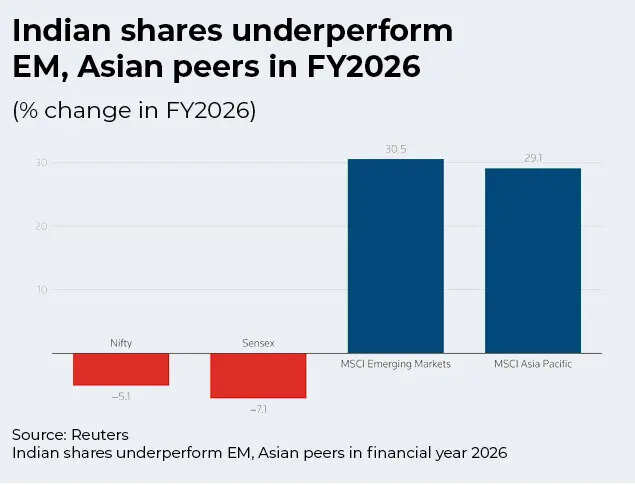
Stock markets are in deep red and in all likelihood so is your investment portfolio since the start of the US-Israel-Iran war. The conflict has been a perfect storm for stock markets globally, and the Indian equity benchmarks, Sensex and Nifty, which had just started recovery after the announcement of the India-US trade deal were hit by the severe shock. Sensex and Nifty are down over 12% from their lifetime highs and investors have lost several lakh crore with the combined market capitalisation of BSE-listed firms down over Rs 30 lakh crore since the start of the Middle East conflict.With global crude oil prices rising and India’s huge import dependence, all positive drivers of the stock market have taken a back seat. A depreciating rupee, flight of foreign capital, and prospects of impact on industry and earnings has investors running for cover. Gold, which is often considered the safe haven asset, has also failed to rise to the occasion for investors, instead seeing high volatility and dropping unceremoniously from its lifetime highs. In such a scenario, what should investors do? It’s the start of a new financial year, and if you are wondering where to put your money – this article has you covered. We asked five experts what they think is the right portfolio strategy for investors at the current juncture, across time frames and risk appetites. The experts also shared lessons from historical shocks for stock markets. Let’s take a look:
What’s The Right Investment Strategy Right Now? What Experts Say
Below is a detailed analysis by five experts on best portfolio allocation strategy, the right investment mix and investment lessons from history:Amitabh Lara, Executive Director, Anand Rathi Wealth LimitedBest Portfolio allocation strategy & mix: In a volatile environment like this, the focus should be on aligning strategy as per goals rather than reacting to short term market movements. For investors with a horizon of 6 months to 1 year, equity exposure may not be appropriate as markets can remain unpredictable in the near term. In such cases, allocating entirely to debt is a suitable approach. Investors can consider options such as gilt funds, and arbitrage funds, for those in higher tax brackets, can offer relatively efficient outcomes.The asset allocation strategy should be guided by the investment horizon, as this determines the level of risk an investor can reasonably take. For short term goals, typically less than one year, a 100% allocation to debt is advisable.For medium term goals, between 1 and 3 years, an allocation of around 70% in equity and 30% in debt will provide a good mix of growth and stability.For long term goals beyond 3 years, equity should form the core of the portfolio. An allocation of around 80% in equity and 20% in debt, with gold playing a substitute of debt portion will be ideal for such a long term portfolio. Within the equity portion, around 50 to 55% should be allocated to large caps, 20 to 25% to mid caps, and the remaining to small caps to ride all market cycles smoothly.Lessons From The Past: Historical data shows that uncertainty due to geopolitical conflicts has generally been for a shorter period of time. On average, geopolitical events have created drawdowns of around 5 to 6% in the Nifty 50, with recoveries often taking place within about a month. Even in situations where conflicts have extended over longer periods, the most significant market reaction has typically occurred in the initial phase of war, followed by gradual stabilisation.Investors should therefore remain aligned with their asset allocation strategy as per their financial goals, continue with SIP investments, and avoid making decisions driven by short term events. Long term market trends are driven by economic fundamentals rather than geopolitical developments. Ajit Mishra, SVP Research, Religare Broking Ltd1. Portfolio allocation strategy (next 6–12 months)In the current environment of geopolitical stress, elevated crude prices, and commodity volatility, a balanced and disciplined allocation is advisable. Equities should remain core at 50–60%, with a tilt towards large caps and domestically driven sectors. Fixed income at 25–30% provides stability and predictable accrual, particularly through high-quality instruments. Gold at 10–15% serves as an effective hedge against uncertainty and currency volatility. Maintaining 5–10% in cash or liquid funds allows tactical deployment during corrections. The emphasis should be on diversification, avoiding aggressive bets, and steadily deploying capital rather than attempting to time short-term market movements.2. Ideal portfolio mix (short, medium & long term)There is no one-size-fits-all allocation; it varies by individual risk profile, income stability, and financial objectives. For short-term needs, a conservative allocation with higher exposure to debt and liquid assets is appropriate. Medium-term portfolios can adopt a balanced mix of equities and fixed income to manage both growth and stability.Long-term portfolios should have a higher equity allocation to benefit from compounding. That said, investors must periodically reassess and rebalance their portfolios as market conditions and personal circumstances evolve, rather than adhering to rigid allocation frameworks.3. Historical context & key lessonsPast geopolitical events such as the Russia-Ukraine War and the Gulf war have typically led to sharp but short-lived market disruptions, alongside spikes in crude and gold prices. Indian equities have historically demonstrated resilience, supported by domestic growth fundamentals. The key lessons are consistent—avoid panic-driven decisions, maintain diversification across asset classes, and use volatility to gradually build positions in quality assets. Markets tend to recover ahead of visible improvement in macros; hence, disciplined investing and patience remain the most reliable drivers of long-term returns.Thomas V Abraham, Research analyst, Mirae Asset ShareKhanIndian equity markets have a resilient track record during geopolitical tensions. Sharp initial dips (at the start of a geopolitical conflict) often give way to robust rebounds, rewarding patient investors who prioritize diversification and measured risk rotation over knee-jerk reactions.Market Patterns: Dips Followed by Strong ReboundsHistory reveals a clear rhythm: conflicts trigger Nifty and Sensex corrections of 4-16% in the opening weeks, but recoveries kick in swiftly—typically within 6-12 months. The current market correction has been steep, with valuations looking attractive for long term investors.Historically, market bounce backs have been above 30+ % post the dips as sentiments improve. This is on account of larger defence spends, higher share of revenue from export oriented sectors such as pharma and IT on account of increased optimism in trade improvements, and a surge in capital expenditure as Foreign Institutional investors return post the high uncertainty phase. From past history, the pre and post war investments trends can be classified as below : Preservation phase:When tensions escalate, focus on shielding capital while spotting selective opportunities. Avoid wholesale portfolio overhauls—instead, refine allocations for stability.Key tilts include:• Core equities (~50% total): Stick to large-caps with minimal debt, emphasizing defensives like non discretionary FMCG, pharma, IT (under current valuations), and stable banks. Please note, these are buys with a long term horizon.• Opportunistic plays : Allocate ~20% of equities (6-10% overall) to defense and infra firms poised for budget boosts, but watch stretched valuations.• Safe havens and Cash buffer (~15%): Gold via sovereign gold bonds (SGBs) or ETFs shines as an equity hedge during volatility spikes and Cash reserves to the tune of 10% of the fresh capital (3-6 months expenses).• Fixed income (~15%): Gilt funds or top-tier PSU bonds deliver steady yields with negligible drawdowns.• Trim aggressively: Dial back leveraged small/mid-caps, where stress amplifies downside risks.Recovery phase :• Reduce share of cash/ gold and increase equities – buy in phased tranches.• Boost defensives (IT, pharma, banks) and capex winners (infra, capital goods) that thrive on rebuilding momentum. Ajit Banerjee, President and Chief Investment Officer, Shriram Life InsuranceUnfortunately, there isn’t any size fit for all concepts in the portfolio allocation strategy under any market conditions. Depending upon the customers age profile, existing financial commitments and liabilities, risk appetite, health condition, the asset allocation strategy can be worked upon. However, remaining agnostic to all of the above conditions for deciding the portfolio allocation, the portfolio mix should be balanced between Fixed Income securities, Equity Exposure either directly or through Mutual Funds or ULIPs, some exposure into precious metals like Gold and Silver to diversify risks and take some exposure into real estate sector through investments in REITS. These can be the composition of the portfolio, however, the proportion of these may vary as per the risk profile, risk appetite, and other factors as mentioned.From an investors perspective, the basic principle for investments into equity should be that it is not meant for short-term investments perspective and should be considered for mid- to long-term investments as short-term equity investments return can be volatile with a potential to swing either way. Therefore, Purely for short-term perspective (0-3 years), we would assume that capital protection would be of paramount importance and hence the predominant portfolio allocation should be in high quality fixed income securities with a fixed maturity profile so that the interim MTM fluctuations don’t impact the investor. Some limited allocations can be made in REITS which is a very stable asset class with some capital appreciation as well. The maturities of these investments should be staggered and of high quality so that the probability of default is negligible.From a medium-term perspective (3-5 years) – The basic portfolio construct for medium-term perspective for an investor who has the ability and intent to invest for a medium-term perspective his/her allocation to Fixed Income can be in the range of (40-50)%, Equity investments either direct or passively through MFs or ULIPs can be (20-30)%, REITS/INVITS (5-10)%, Precious Metals (5-10)%.From a long-term perspective (5+ years) – The basic assumption before recommending the portfolio construct is that the investor has surplus funds available for a long-term period and has reasonable risk appetite and his other financial commitments are taken care off. Therefore, the portfolio construct can be Equity (50-60)%, Fixed Income (10-20)%, REITS/INVITS(10-20)% & Precious Metals (5-10)%. Within the equity portfolio allocation, predominantly it is recommended to invest in large- and mid-cap stocks and limited exposure in small caps as that is a very volatile segment within equities. Investment in Fixed Income and REITs and INVITS should also be of highest quality and required due diligence is done prior to investments.Investments into equity should be done with proper due diligence and stock selection should be done on a bottom–up approach as opposed to momentum buying or selection on social media or financial influencers or mere hearsay.
InCred Money Expect higher energy-driven inflation risk, elevated market volatility, and episodic safe-haven flows into gold, so be defensive, liquid, and selective.
- Emergency fund first: keep 6–12 months of living costs in truly liquid instruments — separate from your investment cash.
- Keep SIPs running. Good time to start looking at small and mid cap funds for SIPs as well as Lumpsum now since the valuations have come down.
- Core equity allocation stays (strategic): favour market leaders with pricing power, secular growth, and strong balance sheets. Treat cyclical/commodity names as satellite positions you add to selectively.
- Opportunity Fund: Be nimble and keep an opportunity fund of 10-15% of your portfolio as further drawdowns can’t be ruled out due to all the geopolitical tensions and US Mid-term elections later in the road.
- Gold & Silver: Both have structural tailwinds so one can have a 10-15% portfolio in Gold and Silver. Since both have run up significantly, better to invest during dips and through SIPs.
Recommended portfolio mixes — short / medium / long (These are starting templates — tweak for age, liabilities, and goals.)
- Short (0–12m): Equities (/SIPs) 35–45%, Cash/war-chest 10–20%, Bonds 20–25% Gold/real assets 5–8%
- Medium (1–5y): Equities 50–60% (/SIPs), Bonds 15–25%, Real assets/gold 5–10%, Cash 5–10%.
- Long (5+y): Equities 60–70%(/SIPs), Bonds 15–20%, Infra/real assets 5–10%, Gold 3–5%, Cash 2–5%.
Lessons from other war-like situations:
- Distinguish cost shock vs structural business problem: brands and companies with pricing power usually recover; commodity-exposed, low-margin players do not.
- Liquidity is king: keep an opportunity buffer. Those who bought in the early weeks after past spikes often secured the best returns.
- Rupee-cost averaging and staggered re-entry beat market timing in most historical episodes. Timing on oil moves rarely produces consistent excess returns for most investors.
(Disclaimer: Recommendations and views on the stock market, other asset classes or personal finance management tips given by experts are their own. These opinions do not represent the views of The Times of India)
Source link